The Hidden Volcano 7 Kilometers From Santorini Just Made Scientists Rethink Everything

A Magma Chamber Nobody Knew About
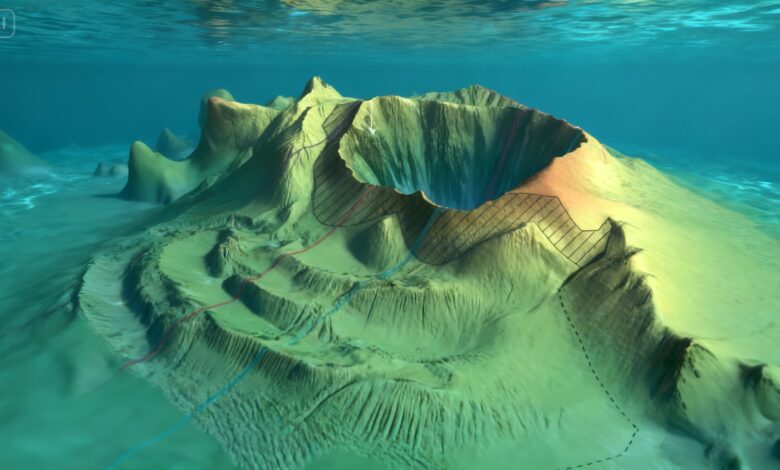
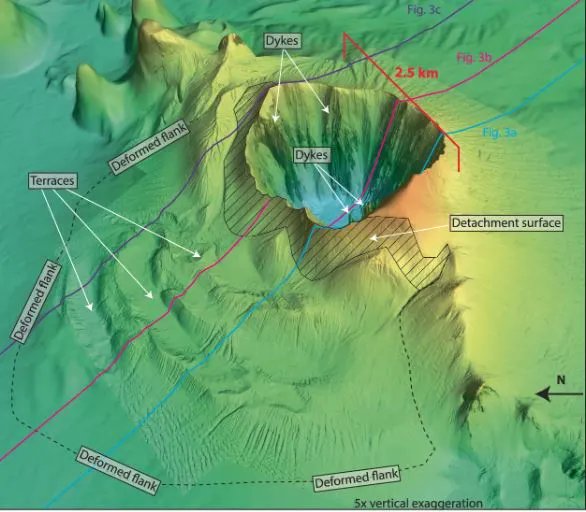
In October 2022, a research team from Imperial College London published a study that should have generated far more attention than it did. Using an imaging technique called full-waveform inversion — essentially a high-resolution ultrasound of the Earth’s crust — they discovered a large, previously undetected magma chamber beneath Kolumbo, an active submarine volcano sitting 7 kilometers northeast of Santorini in the Aegean Sea.
The chamber holds approximately 1.4 cubic kilometers of magma. It has been growing at about 4 million cubic meters per year since Kolumbo’s last documented eruption in 1650. The volcano’s summit rim sits only 18 meters below sea level. Its crater hosts hydrothermal vents discharging fluids at temperatures up to 220 degrees Celsius.
Kolumbo is the most active submarine volcano in the Mediterranean. Until 2022, scientists had no clear picture of what was sitting directly beneath it.
1650 and What History Actually Tells Us
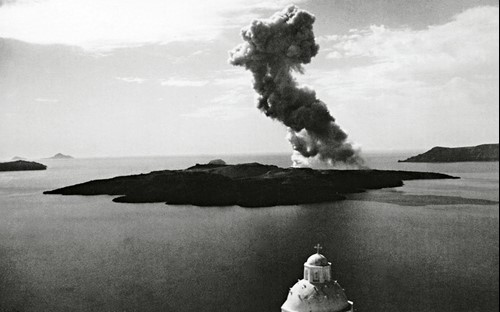
The last time Kolumbo erupted was 1650 CE. The accumulating volcanic cone broke the sea surface. Pyroclastic material spread across the water toward Santorini, 7 kilometers away. Toxic gas clouds swept across the coastline and caused the loss of around seventy lives on the island. A tsunami struck Ios, Sikinos, and Amorgos, with wave heights reaching up to 20 meters in some locations.
That eruption matters now because the magma volume currently in Kolumbo’s chamber is approaching the level that preceded the 1650 event. The researchers who published the 2022 study were careful to note that geological systems do not operate on simple thresholds — this does not mean an eruption is imminent. But the comparison is not a trivial one.
Santorini’s own eruptive history adds context. Around 1620 BCE, the Minoan eruption released approximately 60 cubic kilometers of material, collapsed the caldera that forms the island’s iconic bay, and sent tsunamis across the eastern Mediterranean. The Hellenic Volcanic Arc, formed by the subduction of the African plate beneath the Eurasian plate, has been producing major geological events in this region for hundreds of thousands of years.
What 2025 Changed
In early 2025, the Santorini-Kolumbo system produced its most dramatic activity in the modern monitoring era.
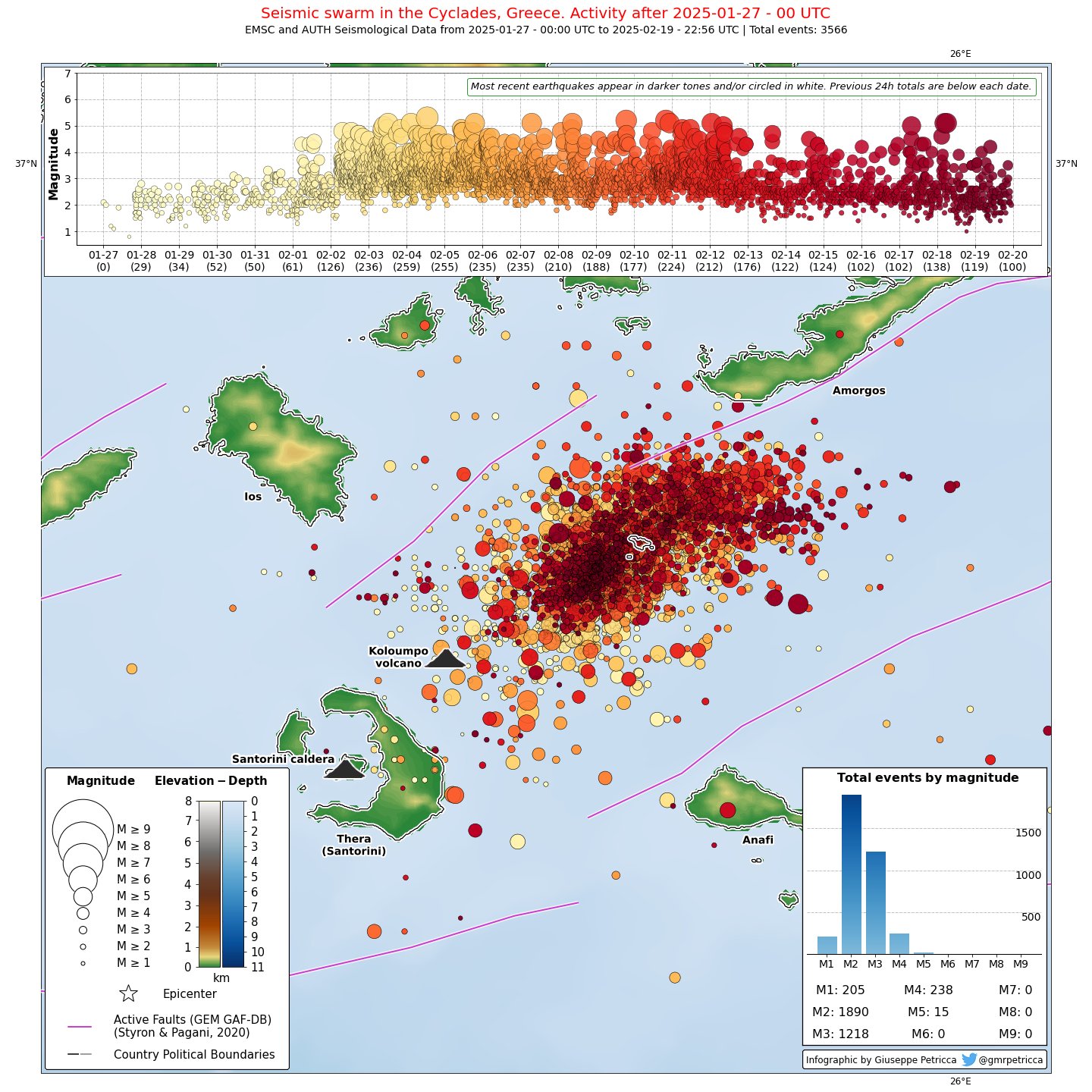
Beginning in mid-2024, satellite data showed the floor of Santorini’s caldera rising slightly. Gas sensors at Nea Kameni registered elevated carbon dioxide and hydrogen. Then, on January 27, 2025, the seafloor northeast of Santorini fractured. Over the next several weeks, more than 25,000 earthquakes were recorded. The strongest reached magnitude 5.3. Greece declared a state of emergency. More than 11,000 people left Santorini by ferry and plane.
Two major studies published in 2025 explained the source.
A September 2025 paper in Nature, led by Marius P. Isken at GEOMAR, reconstructed the subsurface event using seismic, geodetic, and satellite data. A magma-filled dike approximately 13 kilometers long had intruded upward from a mid-crustal reservoir beneath Kolumbo, driving approximately 0.31 cubic kilometers of magma into the crust. Santorini’s surface rose more than 10 centimeters. Kolumbo’s seafloor sank by up to 32 centimeters. The simultaneous inflation at Santorini and deflation at Kolumbo confirmed what had previously only been suspected: the two volcanoes share a deep, connected magmatic system. Researchers described it as two aortas attached at depth to a hidden magmatic heart.
A November 2025 paper in Science, involving researchers from University College London, added a critical detail. By treating each of the 25,000 precisely located earthquakes as a virtual stress meter, the team showed that the seismic pattern matched magma opening cracks in the crust — not tectonic fault slippage, which had been the leading initial explanation. The source of the 2025 earthquakes was not a fault. It was liquid rock moving horizontally through the crust at depths greater than 10 kilometers.
What the News Coverage Got Wrong
When the crisis was unfolding in February 2025, every expert statement being broadcast said the same thing: these are tectonic earthquakes. Not volcanic. No eruption risk.
That was accurate based on what real-time instruments could determine. The seismic signature of a dike intrusion and the signature of fault slippage can look nearly identical to standard monitoring networks. The answer — that the source was magma — came from an analysis that required months and a level of computational intensity unavailable during the crisis itself.
This is not a criticism of the scientists involved. It shows the current state of submarine volcanic monitoring. The gap between what happens on the seafloor and what monitoring networks can identify in real time is real. The 2025 Santorini-Kolumbo crisis is now the defining reference event for what that gap looks like in practice. Kolumbo is one of the best-monitored submarine volcanoes in the world. It still produced a major magma intrusion that was not identified as such until six months after the fact.
What Comes Next
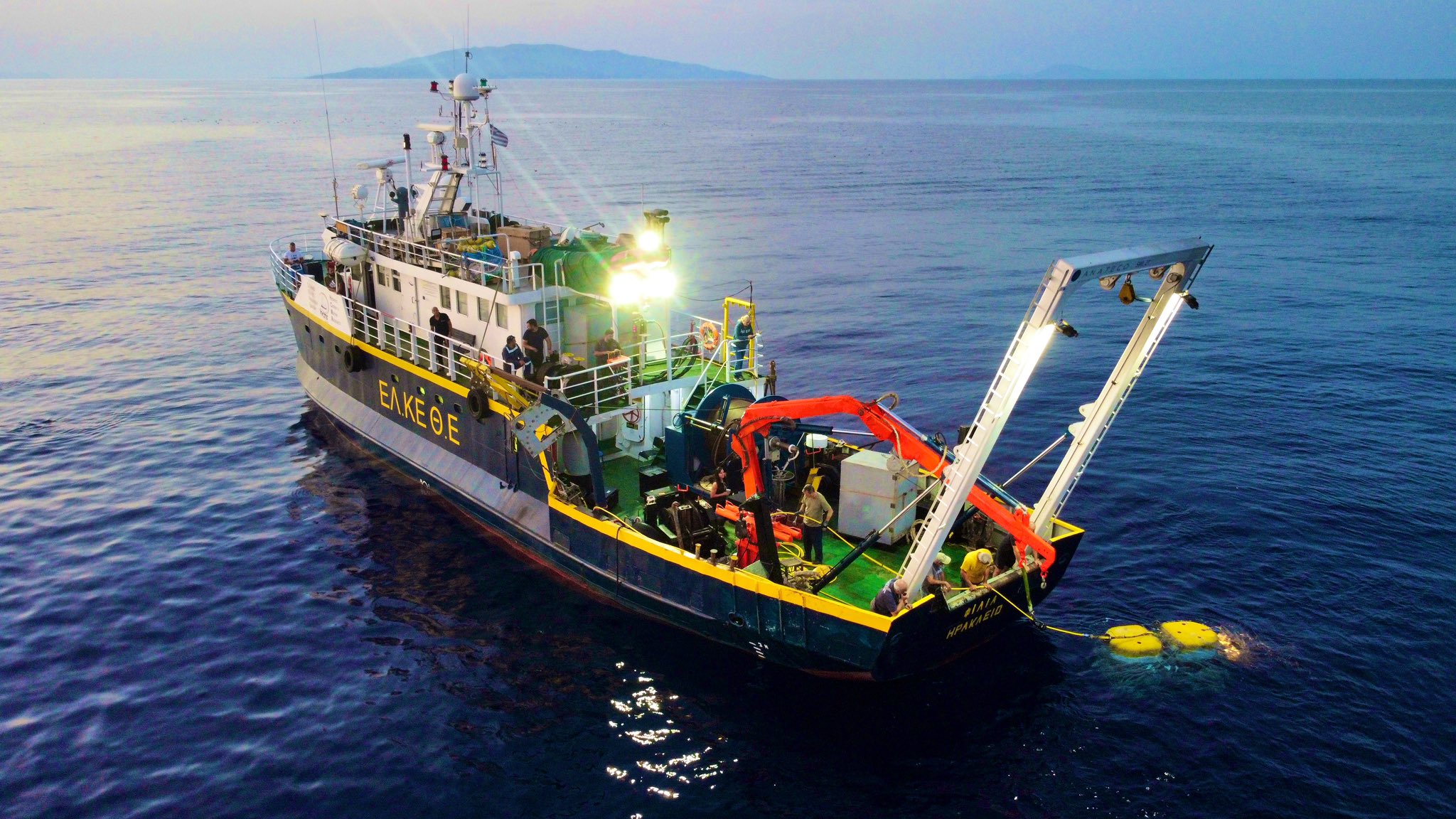
Greece and an international consortium of geophysical institutions are deploying the SANTORY sensor network — permanent instruments inside Kolumbo’s crater and along its flanks — with phased deployments planned through 2026. The goal is continuous, real-time data from a volcanic system that, for most of its history, operated far below the reach of existing tools.
The 1.4 cubic kilometers of magma in Kolumbo’s confirmed shallow chamber, the deeper shared reservoir connecting it to Santorini, and the demonstration that this system can mobilize magma on a scale that produces 25,000 earthquakes in weeks — none of that changes the scientific consensus: no eruption is predicted. But it changes how scientists and emergency planners think about a region that receives millions of visitors every year, where the nearest major submarine volcano is a 15-minute boat ride from the harbor.
The Mediterranean looks calm from the surface. What 2025 established is that the view from 500 meters below is considerably more active than anyone had confirmed before.