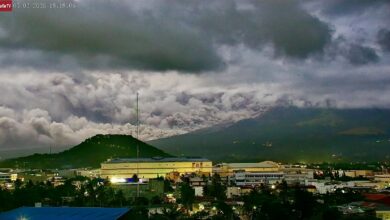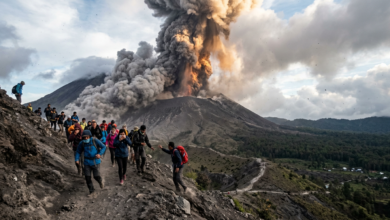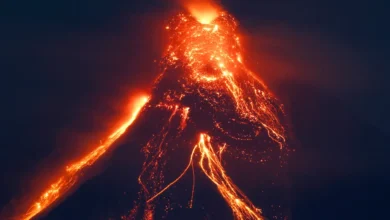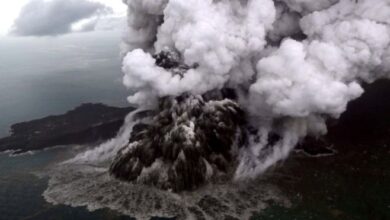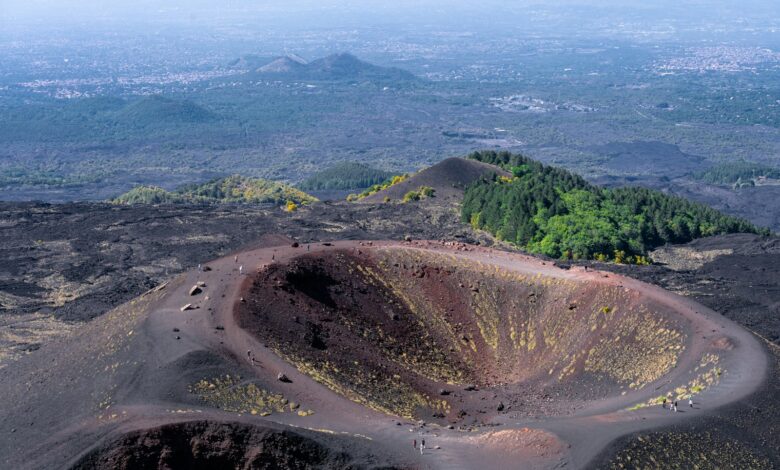
Most people picture Mount Etna as a column of fire — molten lava, towering ash plumes, glowing rivers carving down its flanks. That picture isn’t wrong. Etna is Europe’s most active volcano, towering 3,357 meters (11,014 feet) above eastern Sicily, and it erupts with such regularity that lava flows are practically part of the landscape.
But the most serious hazard Etna poses to the millions of people living around it isn’t volcanic at all.
It’s gravity.
The entire southeastern flank of the volcano — the side that faces the Ionian Sea — is sliding. Not in a single dramatic event, not as a side effect of magma pushing from below, but as a slow, inexorable creep that has been measured continuously for over four decades. And in 2018, an international team of scientists rewrote the textbook on what’s actually driving it. The conclusion changed how the entire risk picture is calculated.
A Mountain That Won’t Stop Moving
Satellite measurements first detected the eastward motion of Etna’s southeastern flank back in the 1980s. GPS networks installed by the Istituto Nazionale di Geofisica e Vulcanologia (INGV) and the University of Catania confirmed it again and again over the following decades. The numbers vary depending on where you measure, but the average comes out to roughly 14 millimeters (0.55 inches) per year for the entire massif sliding to the east-southeast — and parts of the flank closer to the coast are moving 3 to 5 centimeters (1.2 to 2 inches) per year.
That doesn’t sound like much. The thickness of a credit card, year after year. But Etna is a colossal volcanic edifice, and the unstable block of mountain that’s moving covers a significant portion of the volcano’s eastern half. That kind of mass, moving consistently in one direction, has consequences nobody can ignore.
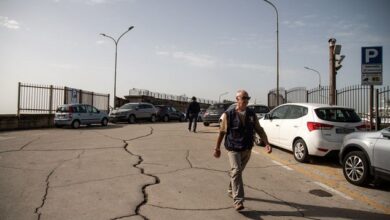
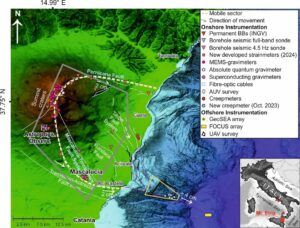
The slide is bounded by a network of faults. To the north, the Pernicana fault — a strike-slip fault that ruptures regularly in shallow earthquakes — separates the unstable block from the stable part of the volcano. Along the southeastern coast, the Timpe fault system, including the Fiandaca fault that ruptured in the magnitude 4.9 Etna earthquake in December 2018, marks the boundary between the moving flank and the seafloor. Together these faults define a slab of mountain the size of a small city.
What Scientists Used to Believe
For most of the past three decades, the working hypothesis was straightforward: Etna’s flank moves because magma pushes it.
The idea made intuitive sense. As magma rises and inflates the volcano’s plumbing system, it deforms the edifice from the inside out. The flank is the path of least resistance, so it bulges and creeps eastward. Under that model, flank instability and volcanic activity are coupled — when the volcano is active, the flank moves more.
The implication mattered. If magma drives the slide, then the danger of catastrophic collapse is greatest during eruptions, and quiet periods are relatively safe. Civil protection planning, evacuation thresholds, and tsunami modeling were all built around this assumption.
In 2018, that picture broke.
The Discovery That Rewrote the Risk Model
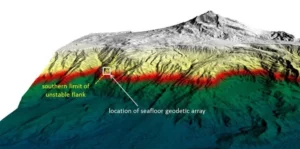
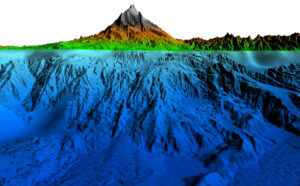
A team led by Morelia Urlaub at the GEOMAR Helmholtz Centre for Ocean Research in Kiel, working with INGV scientists, decided to do something nobody had managed before — measure the underwater part of Etna’s flank directly. Satellite GPS only sees what’s above water. The submarine half of the unstable block, where most of the actual sliding surface lies, was a black box.
Urlaub’s team deployed a network of five seafloor transponders called the GeoSEA array along the submerged southern boundary of the volcano. Every 90 minutes the transponders pinged each other with acoustic signals, measuring distance changes down to the millimeter. For more than a year they recorded slow, steady displacement.
Then between May 12 and May 20, 2017, something extraordinary happened. In just eight days, the seafloor stations recorded up to 4 centimeters (1.6 inches) of sudden displacement — almost a year’s worth of movement compressed into a single week. There was no eruption. There were no large earthquakes. The volcano above sea level was quiet.
What had occurred was a “slow slip event” — a fault rupture that releases stress without generating significant seismic shaking. And when the team correlated their underwater data with the surface GPS records, the pattern they saw was decisive. The center of motion wasn’t beneath the summit, where a magma-driven model would put it. It was offshore, on the submerged slope itself.
The conclusion published in Science Advances was clear: Mount Etna’s flank is sliding because of gravity, not magma. The mountain’s own weight, sitting on a sloping sedimentary basement, is pulling the southeastern half toward the Mediterranean — and it will keep doing so whether the volcano erupts or not.
Why This Matters for Hazard Assessment
The shift from a magma-driven to a gravity-driven model fundamentally changes the worst-case scenario.
Under the old framework, a flank collapse was something to watch for during major eruptions. Under the new framework, the trigger could come at any time — a large earthquake on the Pernicana or Timpe fault systems, an intense rainy season saturating the slope, a slow-slip event that crosses some unknown stability threshold. The volcano doesn’t need to be active for the flank to fail.
And if it does fail catastrophically, the consequences extend far beyond Sicily.
The Tsunami Precedent of 8,000 Years Ago
About 8,000 years ago, a massive collapse of Etna’s eastern flank sent a debris avalanche into the Ionian Sea and triggered a tsunami that propagated across the entire eastern Mediterranean. Computer simulations of that paleo-event show waves striking the coasts of Greece, Libya, and Egypt within hours. The geological record of that ancient tsunami has been mapped along multiple Mediterranean coastlines, with deposits found from southern Italy to the Levant.
A modern repeat would be a different scale of disaster than anything Etna’s eruptions could produce. Catania, a city of more than 300,000 people, sits directly on the moving flank. Messina, with its narrow strait and busy ferry routes, lies just to the north. The southeastern Sicilian coast, the Calabrian coast, the Ionian Greek islands, and the western Greek mainland would all be in the path of a major wave.
What Researchers Are Doing Now
The picture is not all bleak. The same recognition that gravity drives the slide has prompted a major investment in monitoring. The ETNACreep project, led by GFZ Potsdam in partnership with GEOMAR and INGV, is installing creepmeters — instruments that measure millimeter-scale fault movement in real time — across the unstable block. Two are already operating in the central part of the sliding area, with a third planned for the Pernicana fault, the structural boundary that would have to fail for the entire block to come loose.
Combined with the underwater GeoSEA array, satellite InSAR data from the Sentinel-1 mission, and the existing GPS network maintained by INGV, the volcano is now monitored from the seafloor up to orbit. Any significant acceleration in the slide rate would be detected within days, possibly hours.
That doesn’t mean a sudden collapse can be predicted. Slow-slip events like the one in 2017 came without warning, and the leap from creep to catastrophic failure isn’t something any model can yet forecast reliably. What it does mean is that scientists now know what to watch.
The Honest Answer to “Should I Worry?”
If you live in Catania or Messina, the slow slide of Etna’s flank is not an immediate emergency. The 2017 slow-slip event released about 4 centimeters of motion without any surface damage, and there is no published research suggesting an acceleration toward catastrophic failure is currently underway. Scientists studying the volcano have been clear: the timescale of a possible collapse could be years, decades, or centuries. There is no way to know.
What has changed is that the possibility is real, the mechanism is understood, and the monitoring is in place. Mount Etna’s most extraordinary feature is no longer just the lava that flows from its summit. It is the silent, continuous motion of half a mountain, sliding toward the sea — and the recognition that the most serious volcanic hazard in Europe might not be volcanic at all.
Sources and Further Reading
- Urlaub, M., et al. (2018). “Gravitational collapse of Mount Etna’s southeastern flank.” Science Advances, vol. 4, no. 10.
- Murray, J. B., et al. (2018). “Gravitational sliding of the Mt. Etna massif along a sloping basement.” Bulletin of Volcanology, 80:40.
- GFZ Potsdam — ETNACreep Project, monitoring fault creep on Mount Etna’s unstable flank.
- Istituto Nazionale di Geofisica e Vulcanologia (INGV) — Etna Observatory, ground deformation monitoring.